Wednesday, 29 June 2016

Research - Akeelah and the Bee trailer analysis (Drama)

Institutional Information
Akeelah and the Bee is a 2006 drama film directed by Doug Atchison. It is produced by Lionsgate and Lionsgate Films, as well as 2929 Entertainment. The film was released in the UK on 18th August 2006. It was distributed by Lionsgate film. Akeelah and the Bee had a budget of $6 million and had box office takings of $18.9 million dollars, resulting in a profit of $12.9 million dollars.


Synopsis
Akeelah Anderson lives in a rough area of Southern Los Angeles. Whilst at Crenshaw Middle School, she discovers that she has a talent for spelling. She attracts the attention of Dr. Larabee, who offers to train her for the Scripps National Spelling Bee. However, she must work hard to overcome the prejudices in her community, and have self belief in order to achieve.                                                    

Camera


Close up
This close up allows the audience to see how determined Akeelah is to do well. The close up almost forces the audience to be put in the same position as the character. It also gives the audience indication that she is the titular character; she dominates the frame and is the subject that is in focus.


Two shot
This two shot helps convey the disgust on their faces, and therefore the audience take a disliking to them. The two shot and the proxemics suggest that the two characters are close and so there is a sense of them going against Akeelah.

Mid shot
This mid shot makes Akeelah's brother dominate her. This could reflect how his views about white people are dominant in their community. The fact that he is in focus makes him appear to be an imposing figure, hence turning the attention to him, as Akeelah is doing.

Two shot
This two shot evokes audience pleasures such as happiness because we know from the rest of the trailer that Akeelah is quite a shy character. The proxemics of the actors in this shot suggest that they are close, and it subverts the idea that there is a divide between the black and white communities. It is enjoyable for the audience to see that Akeelah has befriended someone throughout the process.


Close up
The above close up shot strikes emotion in the audience because they can see how close Dr Larabee and Akeelah have grown whilst studying for the Spelling Bee, and essentially how they support each other. Therefore it helps to present both Akeelah and Dr Larabee as warm characters.


Long shot 
This long shot presents Dr Larabee as the stereotypical teacher. He looks dominant compared to Akeelah, and whilst he is preaching her in the situation (his control over what is happening is also shown through the use of props) he remains a likeable character. This is because we know that  he truly wants Akeelah to succeed.
Medium long shot
The above medium long shot is effective because it is the last camera shot of the trailer. It reveals the audience applauding. Hence it hints at the success of Akeelah and evokes emotions such as joy in the trailer.

Editing - Titles
Titles
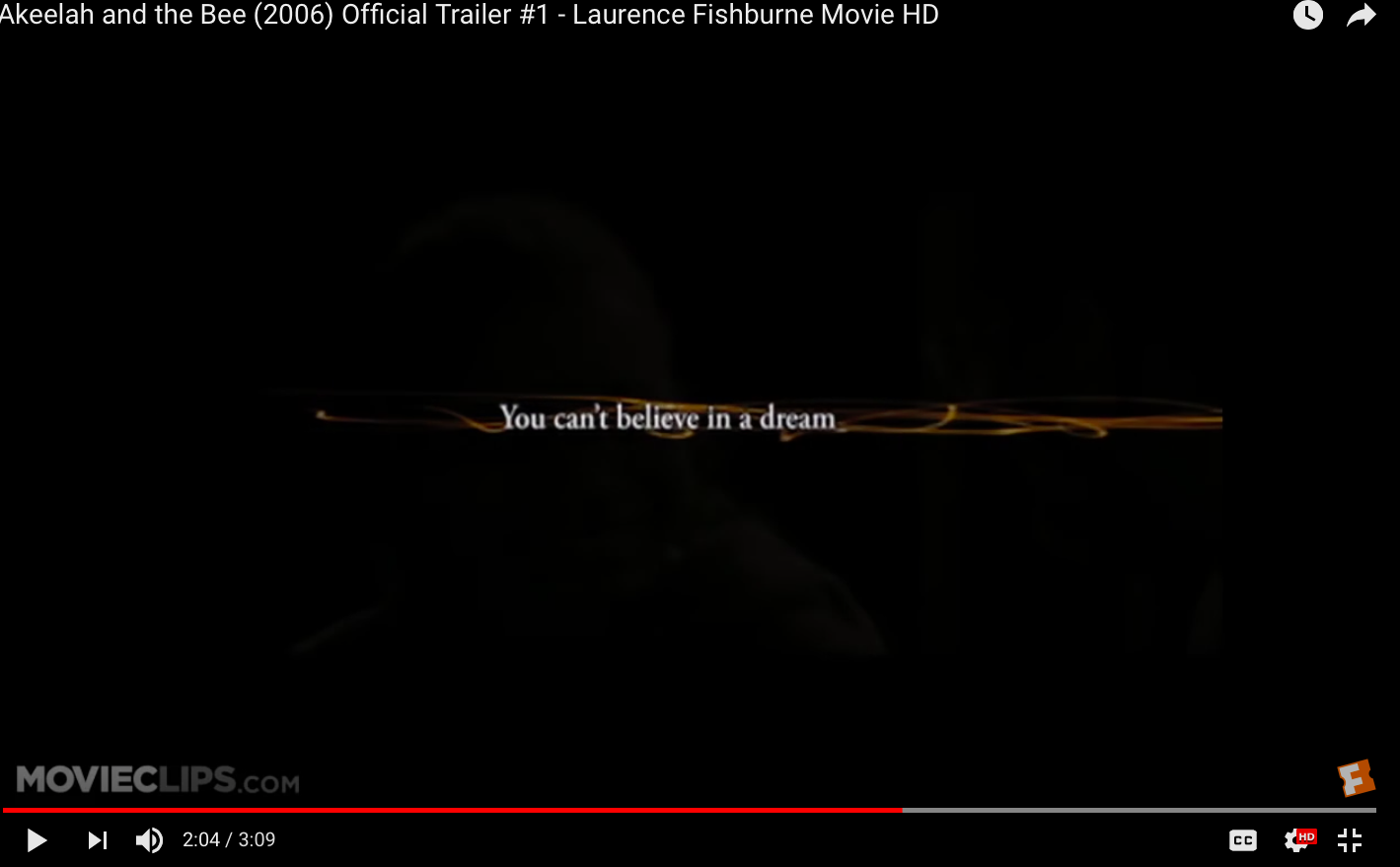
These titles are interesting because they use the colours gold and white. Gold connotes victory which links to how Akeelah wants to win the contest, and is similar to the colour of honey bees. The white could also symbolise Akeelah's innocence. The connotations of these colours are also shown in the titles below.

There are a variety of transitions used in the trailer. These include fade to blacks and fade to whites. The fade to white occurs at 0:45. This is effective because it merges with the sunlight in the next scene. The fade to blacks help to build up tension as the audience can  only rely on sound to see what is happening.

Mise en Scene
The mise en scene of this trailer is largely based around a school and the community. This mise en scene is suggested through costume - most children are wearing white. Therefore it also links to the innocence of them. The lighting is low key and this could reflect how Akeelah doesn't enjoy school because she is bullied. This relates to the lighting because it is not bright. The setting of school is substantiated by the costumes of staff - the principal is wearing a suit which signifies his authority. However, it is not a stereotypical suit (black)  so points to the fact that he struggles not to be dominated by more troublesome students. 
The proxemics of Akeelah and Dr Larabee later on in the trailer suggest that they are close. This is contrasted with that of Akeelah and her brother, suggesting that their relationship is fraught. 
The community is at first presented as divided because of the low key lighting and old buildings and distant proxemics. However, as the trailer progresses, it is clear that the spelling bee is the thing that brings the community together.

Sound 
The trailer has a mixture of diegetic and non diegetic sound. One of the elements of non diegetic sound that the trailer possesses is a voice over. It is the voice of Akeelah. Therefore it immediately suggests to the audience that she is a prominent character. It also puts the audience in the position of the character and allows them to empathise with them. As a result, it has more impact.
The diegetic sound included in this trailer is dialogue. This allows the audience to see the relationships evolve between the characters.

Friday, 24 June 2016

Research Task: Codes and Conventions

Below are codes and conventions of the dark fantasy genre.

Stereotypical characters:
Antagonist - an antagonist is key to the "dark" element of dark fantasy. Stereotypically the role of the antagonist is taken by a male, as stereotypes of the social world say that men are the stronger and scarier sex. This often leaves the role of the protagonist or victim to be taken by the female; they are also stereotypically seen as being weaker than men. However, there are many fantasy films where the antagonist is female such as Maleficent (2014). To be specific this is more an action fantasy film but I think it is a relevant example. Other female antagonists include the witch in Snow White.

Victim/hero - there is usually a victim who becomes an object of sympathy for the audience. We will them to triumph and become the hero, which sometimes occurs in traditional fantasies.For example Peter Pan triumphs over Captain Hook. In dark fantasies, the victim is often the main character as it is easier to focus on what the antagonist is inflicting upon them.

Themes

  • Curses
  • Oppression of victim
  • Good versus evil
  • Quest
  • Death
  • Imagination
  • Surrealism
Note that not all of these themes will appear in every dark fantasy film.


Locations:

  • Forests - they are surreal locations and often the subject of nightmares.
  • Creepy buildings - makes it more realistic
  • Graveyard - promotes the idea of death.

Narrative conventions of the dark fantasy genre:
  • In dark fantasies triumph is often made especially difficult, with the villain possessing a strong hold over the hero. Due to this, trailers often indicate that the film will not return to its original state of equilibrium or end happily.
  • In all genres of fantasy there is an element of mixing reality with fantasy. This makes it confusing yet engaging for the audience; they are put in the position of the character. With dark fantasy this mixture makes a film more scary as the audience can imagine the events happening to them.
  • Stereotypically the role of the villain (sometimes called antagonist) is taken by a male, as stereotypes of the social world say that men are the stronger and scarier sex. This often leaves the role of the protagonist or victim to be taken by the female; they are also stereotypically seen as being weaker than men. However, there are many fantasy films where the antagonist is female such as Maleficent (2014). To be specific this is more an action fantasy film but I think it is a relevant example. Other female antagonists include the witch in Snow White.
  • A lot of the time something bad will occur to disrupt the equilibrium (for example a curse) and put the victim at the hands of the antagonist. Usually, given the horror elements, attempts to overcome or kill the antagonist will fail, or be incomplete.
  • There is normally an element of "black magic". This gives the audience the impression that the antagonist is using magic to work against the victim or protagonist. It contrasts with most fantasy films, where magic brings great joy. (An example being Peter Pan).
Conventions of trailers for dark fantasy films:
  • They usually start off using a scary non diegetic soundtrack to make the audience feel uneasy and be immediately suggestive of the darker side of the genre. Often this will be added to by turning innocence into evil. For example children's laughter is modified to sound sinister.
  • Trailers usually start slow before picking up pace to reflect the action or horror onscreen. This can help evoke a range of audience pleasures specific to darker films, for instance fear or surprise (at the fairytale/fantasy being dark)
  • The soundtrack will get louder and increase in tempo to match the editing/narrative
  • Trailer editors and producers usually select the scariest moments of the film to feature in the trailer. This is to increase anticipation surrounding the film. However, whilst trailers often show clips in a non linear way, they must be mindful of the fact that one of the purposes of a trailer is to introduce the narrative to the audience.


Thursday, 23 June 2016

Research Task: Deciding on a specific genre

I am thinking of creating a dark fantasy film trailer. Therefore I want to make it clear to the audience what genre it is. In order to do this, I need to research the conventions of trailers for films that fall within the dark fantasy genre.

What is the dark fantasy film genre?
Dark fantasy combines elements of the fantasy, horror and action genres. They utilise a fantasy (made up) setting like almost every fantasy film. For instance, Lord of the Rings uses Middle earth as its setting. However, the main difference with a dark fantasy film is that they take classic fairytale conventions and make them scary. Some examples include Pan's Labyrinth (2006), Coraline (2009) and Snow White: A Tale of Terror (1997)
Pan's Labyrinth (2006) stars Ivana Baquero and Doug Jones. It explores themes such as magic, immortality and danger. Coraline (2009) stars Dakota Fanning as a voice actress and explores danger, parallel worlds and what it means to be family. Snow White: A Tale of Terror changes a well known fairytale into a horror story.


Pan's Labyrinth (2006)


Coraline (2009)
Snow White: A Tale of Terror (1997)


Rationale behind choosing to focus on the dark fantasy genre:
The reason for me selecting this genre to work in was because I feel like it will enable me to build on the skills learned last year (darker elements, horror) whilst not emulating all the codes and conventions. I am also enthralled by the elements of fantasy (for example, magic) and would like to challenge myself by using more professional editing techniques and perhaps even special effects.
For my analysis, I will predominantly be focussing on the dark fantasy genre, for obvious reasons. However as elements cross over to the different types, I will also look at some action/thriller fantasies to see how I can incorporate a wide range of components into the genre, making it more interesting.

Rejected genres
Before coming to a decision, I considered many different genres. Two main genres that I could have selected were: Horror and Romance. To ensure that I was making an informed decision, I conducted some research into the conventions of these genres.

Horror film - basic codes and conventions

  • Low key lighting to set a sinister mood
  • Jump cuts to give pace, shock the audience and keep them engaged
  • An antagonist who harms the victim
  • Tracking and Point of View shots to put audience in the character's position, close ups to show emotion
  • Red and black are key colours - red connotes blood and danger, black connotes darkness and power
  • Weapons are used as common props
  • Non diegetic soundtrack or sound effects (screaming) to build tension
  • Creepy locations
I was aware of the horror genre from my AS studies and though I could improve, I don't want to emulate exactly the skills learned last year. I would need to think of a more complex narrative, and it would need to be done properly. There would also have to be a lot of effort put into creating verisimilitude, for example with make up using fake blood. I do not feel that the horror genre would allow me to sufficiently progress or display my skills, as I did a horror/thriller film for my AS coursework. Therefore I rejected the horror genre.

Romance film - basic codes and conventions
  • Boy meets girl - common narrative
  • Themes of love, heartbreak, falling for someone
  • Red is a symbol - love, roses
  • Follows ordinary people - verisimilitude
I decided to have the romance genre as a contender because it is the type of film I would usually watch myself. However I feel that for this purpose it would be hard to do a good job; I'm not sure I can find willing actors and I wouldn't want the narrative to be too cliché or predictable. Hence I dismissed the romance genre.


Research Task: Defining genre

What is genre?
Genre in the English Language comes from the same French word which relates to "type" or "class". It is a way of identifying what group a film belongs to, and what topics are likely to be covered in the narrative. There are many different types of genre, as well as sub genres or hybrids. These are a subcategory of the film, or a mix of two different genres. Once a film maker and their team has decided on a genre, there are a variety of ways that the genre can be conveyed to the audience. This is usually done through utilising conventions.

What are Genre Conventions?
Genre conventions are the stereotypical components that movies of a certain genre mostly conform to, for example, Romantic films follow a conventional boy meets girl narrative.
Genres and their conventions:
  • Romance - red connotes love so is a common colour. They usually follow a typical "boy meets girl". Often a heartbreak acts as a disequilibrium. As the narrative progresses, the disequilibrium is normally followed by a reconciliation, which shows the equilibrium has been either partially or fully restored. Though not as popular, in recent years romance films have become less gendered to accommodate for LGBTQ+ Communities. This progression continues to be seen.
  • Horror - there is normally an antagonist who sets out to harm the victim/protagonist. This acts as a catalyst to frighten or unsettle the audience. Red connotes blood and danger, black connotes darkness and power, meaning they are common colours. White may also be used as it connotes innocence, thus showing the juxtaposition between good and evil (represented through victim and antagonist). Weaponry and death are also common themes due to the harm that is inflicted onto the characters.
  • Thriller - thriller films encompass many different elements. Essentially a thriller film has components that serve to thrill or excite the audience. This usually results in the film being fast paced, and so the thriller genre lends itself well to features of the science fiction or horror genres, for example. The editing fits with the pace, meaning that it usually includes lots of jump cuts and sometimes no continuity editing. A thriller film is often centred around an exciting narrative, which could be a mission or quest. This makes the audience spur the protagonist on and get more involved in the narrative.
  • Adventure- adventure films are not too dissimilar from the narratives seen in thriller films. Usually the main character (normally protagonist) will go on a journey. During this, lots of things will happen to increase the pace of the narrative. The protagonist may encounter danger. This could act as the disequilibrium. There are usually themes of triumph and self discovery in adventure films.
  • Fantasy- the fantasy genre mixes elements of reality with make believe. Sometimes real life situations are made surreal, and an environment of verisimilitude is created to confuse the audience. This uncertainty makes them more captivated by the narrative. Magic and mythical creatures are popular features of fantasy films.
  • Action - often paired with adventure. These films focus on action, perhaps including sports, missions and conflict. The camera work is usually fast to reflect the action, using tracking, point of view and close up shots. The editing is also fast paced.
  • Biographical - biographical films are used to document, promote or celebrate the work and lives of people. This person/people are usually in the public eye (or have been) to make it more enjoyable and interesting for the audience. Often directors will want to achieve an accurate portrayal of the person, so will base it on a autobiography and/or work with family and friends of the people being portrayed.
  • Comedy- comedies are created to entertain people and make them laugh. Therefore they usually contain one or more foolish or flamboyant characters, who become an object of mockery for the audience. A lot of the time, situations are made relatable to make it even more engaging. A character will sometimes use direct address by looking down the camera to initiate laughter.
  • Sci-Fi - science fiction films have futuristic elements, and are often set in dystopian societies. There is frequently science based stories, such as aliens or a planet other than Earth.
  • Drama - drama films often cover hard hitting or important subjects such as divorce or political movements. However, unlike documentaries, there is more of a "narrative" to them and they involve more acting. There is normally frequent use of close up shots to convey the emotions of characters to the audience.
  • Documentary - documentaries are created to inform and raise awareness of events, or the life of a person. However, unlike biographical films, documentaries about people usually include interviews with family and friends, sometimes even the person themselves. It will often include real footage, or "home videos".
  • Teen/Coming of age films - these films include themes that most teens can relate to, and most characters are teens. They are sometimes referred to as coming of age themes because they are about someone/a group of people on their journey into adulthood.
  • Family - family films have narratives that appeal to the whole family. Some aspects will be educational or the narrative will have a moral behind it, for children. To keep adults entertained, family films often include innuendos and adult humour.
Genre types and example films
Horror - The Blair Witch Project (1999) It Follows (2014)
Thriller - Inception (2010) The Pelican Brief (1993)
Romance - Letters to Juliet (2010) The Notebook (2004)
Drama - What Maisie Knew (2012) Suffragette (2015)
Family - Home Alone (1990) The Incredibles (1964)
Comedy - Mr Bean's Holiday (2007) Bridesmaids (2011)
Action adventure - Indiana Jones and The Raiders of The Lost Ark (1981)
Biographical - The Theory of Everything (2014) Steve Jobs (2015)
Fantasy - The Hobbit: An Unexpected Journey (2012)
Teen - Mean Girls (2004) The Breakfast Club (1985)
Crime - Dial M For Murder (1954) Now You See Me (2013)
Film Noir - Laura (1944) The Lady from Shanghai (1947) Chinatown (1974)
Animation - Up (2009) Inside Out (2015) Finding Nemo (2003) 
Seasonal Films (Christmas/Halloween etc) - Nativity! (2009) National Lampoon's Christmas Vacation (1989) The Holiday (2006) 
Documentary - Amy (2015)

Hybrids and Sub genres:
Hybrids of Genre or Sub genres have come about because with expansion of the film industry, filmmakers found it hard to create a successful film which conformed to just one genre: the industry was become increasingly competitive. Therefore by combining elements of different genres, they could generate more audience interest.

Hybrids and Sub genres: Examples
Romantic Comedy - Just Go With It (2011)
Historical Drama - The Book Thief (2013)
Dark Fantasy - The Nightmare before Christmas (1993)
Future Noir Movies - The Terminator (1984)
Whodunnit/Detective movies - Murder Most Foul (1964)
Musical Family Films - The Sound of Music (1965)

Subverting Genre Conventions:
If something subverts something else, it is going against it. Hence, in film, the movie can subvert our expectations of the genre. This is not usually done accidentally, it is done for effect and allows the audience to encode alternative meanings from the film.

Fixed and Repertoire Elements
Over the years, a variety of things i.e. iconographic props have meant that genres now include a repertoire (range) of elements rather than one specific thing (fixed elements). The repertoire of elements has also been expanded now we see more films which subvert conventions.

Genre and Audiences
The genre is important to the audience because normally people warm to a certain genre. Therefore they are more likely to enjoy the film if they know what genre it is. This is an example of audience pleasures. They will also be able to tell if it is suitable for, i.e., their family to watch. By their very nature, some genres such as horror are unsuitable for younger audience because they contain distressing scenes and violence.

Genre and Institutions
An understanding of genre is key to the smooth running of institutions. For example, the British Board of Film Classification (BBFC) is an institution. They would need to have good knowledge of the horror genre and give films in genre quite high certificates/ratings (i.e. "15", see British Board of Film Classification post) to prevent receiving complaints.

* Some of this post may be similar to the Understanding genre post that I wrote for AS. However, I have tried to modify and expand it to show how my knowledge has developed.

Wednesday, 22 June 2016

Research: Chosen Media (continued) - trailer titles

Titles are an important part of the editing process. They add another dimension to the trailer, and either help promote the cast, narrate the story or informing the audience of the awards and accolades the film has won/is nominated for.

The Spectacular Now (2013) trailer titles
Publicises cast and performance
The type of title above promotes the performances of cast members. If they have been well received by critics, then the audience could be more inclined to go and see the film, increasing box office takings.


Context/Background
 This title gives the audience context or background. By telling the audience the writers' previous work, they can gage whether the film we be of interest to them; they could be of a similar vein. It could also surprise them, and make them re-evaluate any preconceived ideas.
Award/accolade
By including any awards that the film has either won or been nominated for, it gives the film status. This could make the audience want to go and see it, because they realise it must be good. Therefore it helps the trailer adhere to its primary purpose of promoting the film.
Main Title
The main title at the end reinforces the name of the film, teased in the editing (see below). By putting the title of the film at the end it has more of an impact on the audience. They are more likely to recall the name of the film and perhaps want to go and see it.

Editing
The editing plays on the title of the film by emphasising the word "Now". It makes the trailer current and puts the audience in the moment, increasing anticipation and excitement surrounding the film, as well as giving a sense of urgency - suggesting the audience have to go and see the film.


The King's Speech (2010) Trailer titles (narrative)

Narrates story

The type of title above acts as a caption, accompanying the moving footage. It also helps to reinforce and explain events for the audience.
Promotes cast
This title helps to promote the cast in the film. They will often be well renowned actors and actresses, as it gives the film a selling point. In this instance, Colin Firth is a famous actor. If someone is a fan of a particular cast member, it could be the reason they go and see the film, so it is important to promote who features in it. By including any awards the person has won or been nominated for, it makes the audience realise the quality of the acting.


Mamma Mia! (2008) Trailer titles (time and star system)


Time indicator
This slide indicates to the audience when the film will be released, so they can prepare to go and see it. If the date is not close, the film producers can build anticipation and hype early on, it will be discussed and promoted.

Star system 
Some trailers put the name of the cast member on footage of them, so that the audience can easily match up the name with a face. This is different to the name being on a black screen. In this case, the audience are being told that Amanda Seyfried stars in the film.

Reflection
Conducting more specific research into the titles that trailers use has made me realise the diversity of them, and how the genre of the film may cause them to differ. It will be interesting to see what types of titles are used for the genre that I end up choosing; this will inform the editing process.


How has my research informed my choice of product?

My research has confirmed my initial thoughts that I would like to produce a full trailer. Although this is longer and therefore take longer to produce, I feel that a full trailer will allow me to explore the narrative better, and display a more complex use of editing. As a result, I hope that it will be a better platform on which I can exhibit my skills. I wish to show progression from my AS work to A2, which I want to be more sophisticated. Note that I have only analysed one full trailer so far because of the fact that there is more to discuss with full trailers, so the analysis is different.

What have I learned?
I have learned through analysing mise en scene, editing, camera and sound that there are a number of conventions which the majority of trailers follow. I am going to conform to some of these conventions when I produce my own trailer. I feel as if my research has expanded my knowledge of the editing used in trailers, as it is a compilation of footage it makes editing a pivotal part of a trailer.

What do I need to do next?
Next, I want to have a more in depth look at the conventions of full trailers, as teaser and full trailers have different purposes. I also want to make a firm decision with regards to the genre of the trailer.

Research Task: Chosen Media

For my product, I am going to create a full trailer. A trailer is a compilation of footage from the film. This is heavily edited and often uses "best bits" to portray the film in the best possible light to the audience. Trailers are usually non linear as they only want to show the most interesting parts. However, they also introduce the narrative to the audience; it will need to make sense. If the audience are engaged with the story, they will want to see the film. A film may have a teaser trailer, but as these are a little short, I am going to create a full (or main) trailer.

Conventions of a full trailer:
  • Music - usually non diegetic in the form of a soundtrack. This helps to add tension and atmosphere to the trailer. It often builds to a crescendo before ending simultaneously with the trailer. 
  • Dialogue - conversations between characters frequently entail one liners. This makes the trailer seem more dramatic and exciting. If the dialogue is only one line, it can fit in well with the tempo, loudness and rhythm of the trailer. Having one liners may also make it easier for the producer to fade the music as there is a smaller proportion of the music they need to make quieter. 
  • Montage - a series of edited shots show the key points in the narrative. Trailers often alternate between the montage and 
  • titles.
  • Star system - titles showing the names of cast/key crew (for example, Director) are shown. Often a shot of the cast member will be shown before the title, allowing the audience to connect the actor/actress with the name. These do not usually appear until the end of the film.
  • Voice overs - often used to narrrate the trailer or give background to a film. They help put the audience in position of a character or the narrative, making it more engaging.
  • Interesting camera angles may be used to capture the attention of the audience.
  • Sound bridges are often used to give the trailer more continuity.
  • Institutional logos (for example, The Weinstein Company) are displayed at the start of the trailer
  • Non linear structure

Silver Linings Playbook (2012) full trailer

The above trailer conforms to the following conventions:
  • Institutional logo (TWC)
The Weinstein Company institutional logo

  • Non Diegetic music
  • Non linear structure/order
  • Dialogue
  • Interesting angles i.e. close up of book
  • Montage of clips
  • Star system at end (shot of cast member next to their name)
An example of publicising cast

It subverts the following conventions:
  • Voice over (none featured). Voice overs may not be appropriate for a comedy/romantic drama film.